

Every winter, millions of families face the same worry: will the flu find its way into our home? The question isn't just about whether someone will get sick—it's about understanding how this virus moves through the spaces where your children play, where your elderly parents visit, and where your family gathers.
Recent research reveals that influenza spreads through pathways many of us never considered, particularly through the air we breathe indoors. For mothers managing busy households, this knowledge transforms how you protect the people you love most.
This article breaks down exactly how the flu spreads, with a special focus on the role indoor air quality plays in transmission. You'll discover practical, science-backed strategies to reduce flu risk in your home, from ventilation improvements to filtration systems that actually work. Most importantly, you'll learn how to create a healthier indoor environment without complicated routines or expensive recurring costs—because protecting your family shouldn't require a subscription.
Understanding How the Flu Spreads
The influenza virus doesn't need much to move from person to person. When someone infected coughs, sneezes, or even just talks, they release respiratory droplets carrying the virus into the surrounding air. These droplets come in different sizes, and that size difference matters more than most people realize.
Respiratory Droplets and Aerosols
Larger droplets—typically greater than 5 micrometers—tend to fall to surfaces relatively quickly, usually within three feet of the source. This explains the traditional advice about keeping distance from sick people. But research published in PNAS revealed something surprising: 39% of fine aerosol samples (particles 5 micrometers or smaller) collected from flu patients contained infectious virus. Even more striking, the study found that sneezing and coughing weren't necessary for infectious aerosol generation.
Smaller particles, called fine aerosols, behave differently than larger droplets. They can remain suspended in indoor air for extended periods, traveling on air currents throughout a room or even between rooms. CDC research on airborne transmission confirms that influenza has evidence supporting possible small-particle aerosol transmission under natural conditions, sometimes at distances greater than three feet within a defined airspace.
Pre-Symptomatic and Asymptomatic Spread
The timing of contagiousness adds another layer of complexity. According to the CDC, infected people can shed influenza virus starting about one day before symptoms appear and continuing for five to seven days after becoming sick. Your child might be spreading the virus before you notice the first sniffle. Your parents might be contagious before they mention feeling tired.
Surface Transmission
Surface transmission represents a third pathway, though CDC guidance indicates this happens less often than airborne routes. When droplets land on doorknobs, light switches, or countertops, the virus can survive for hours. Someone touching that contaminated surface and then touching their mouth, nose, or eyes can become infected.
The key insight: flu transmission happens through multiple pathways simultaneously, with airborne spread playing a more significant role than many families realize. This understanding shifts the focus from just washing hands and covering coughs to also considering the quality of air circulating through your home.
Why Clean Air Matters During Flu Season
Clean indoor air doesn't eliminate flu risk entirely, but it fundamentally changes the equation. The concept is straightforward: if airborne virus particles are the problem, reducing their concentration in your home's air reduces exposure for everyone breathing that air.
CDC guidance on cleaner air frames this as lowering harmful germs and viruses in the air, particularly important because respiratory viruses can build up more indoors than outdoors. Think of it like diluting a concentrated solution—the more clean air you introduce, the lower the viral load in any given breath.
Air changes per hour (ACH) serves as the standard metric for measuring how quickly air in a space is replaced or cleaned. CDC and NIOSH ventilation guidance recommends aiming for five or more air changes per hour of clean air, using any combination of outdoor air ventilation and indoor air cleaning devices. This target isn't arbitrary—it's based on how quickly clean air can dilute and remove airborne contaminants.
The math behind air changes reveals why this matters. CDC ventilation tables show that at two air changes per hour, removing 99% of airborne contaminants takes about 138 minutes after generation stops. Increase that to six air changes per hour, and the same 99% removal happens in just 46 minutes. In practical terms: a well-ventilated playroom clears viral particles three times faster than a poorly ventilated one.
A systematic review published in Indoor Air examined the relationship between ventilation and infectious disease transmission, finding strong and sufficient evidence for an association between ventilation, air movement, and the spread of infectious diseases including influenza. The evidence supports what common sense suggests—stagnant air allows viral particles to accumulate, while moving, filtered air continuously removes them.
HEPA filtration technology addresses the particle-size challenge directly. EPA defines HEPA filters as capable of removing at least 99.97% of airborne particles at 0.3 micrometers—the most penetrating particle size. Since flu-carrying aerosols fall within the range HEPA filters capture effectively, these systems can significantly reduce airborne viral load.
The limitation worth understanding: even excellent air cleaning doesn't eliminate close-range transmission risk. When someone coughs directly near you, the initial cloud of droplets and aerosols reaches you before ventilation systems can act. Clean air works as a continuous background protection, lowering baseline risk throughout your home rather than creating a protective shield around individuals.
Practical Steps to Improve Air Quality at Home
Improving your home's air quality doesn't require a complete HVAC overhaul or industrial equipment. Strategic upgrades and consistent maintenance deliver measurable results that protect your family during flu season and beyond.
Upgrade HVAC Filters
Start with your existing HVAC system. Use MERV 13 or higher filters if your system can handle them. These filters capture smaller particles than standard fiberglass filters, including the aerosol-sized particles that carry influenza virus. Check your system's specifications before upgrading—some older systems can't handle the increased resistance of higher-rated filters without modifications.
Filter maintenance matters as much as filter quality. A MERV 13 filter clogged with dust performs worse than a clean lower-rated filter. Set a calendar reminder to inspect filters monthly during heavy-use seasons and replace them according to manufacturer recommendations or sooner if they appear dirty.
Use Portable Air Purifiers
Portable air purifiers offer targeted protection for rooms where your family spends the most time. Follow CADR sizing guidelines:
-
200 sq ft room: look for a CADR around 130 cubic feet per minute (CFM)
-
400 sq ft room: look for a CADR around 260 CFM
Undersized units run constantly without achieving adequate air changes, while properly sized units cycle air efficiently.
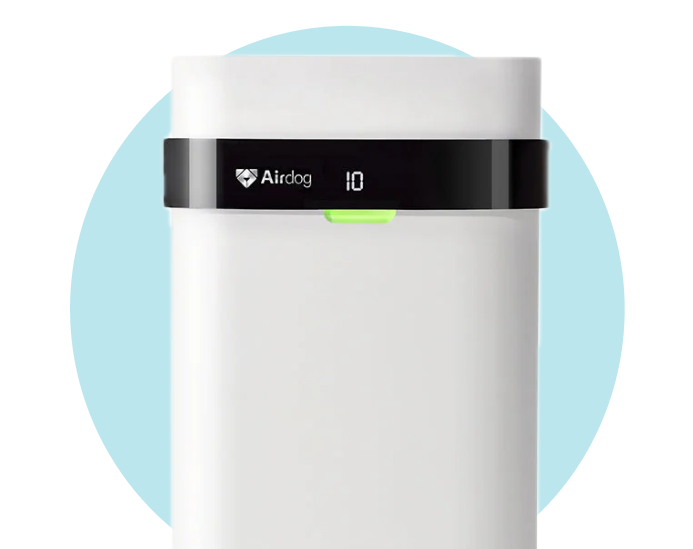
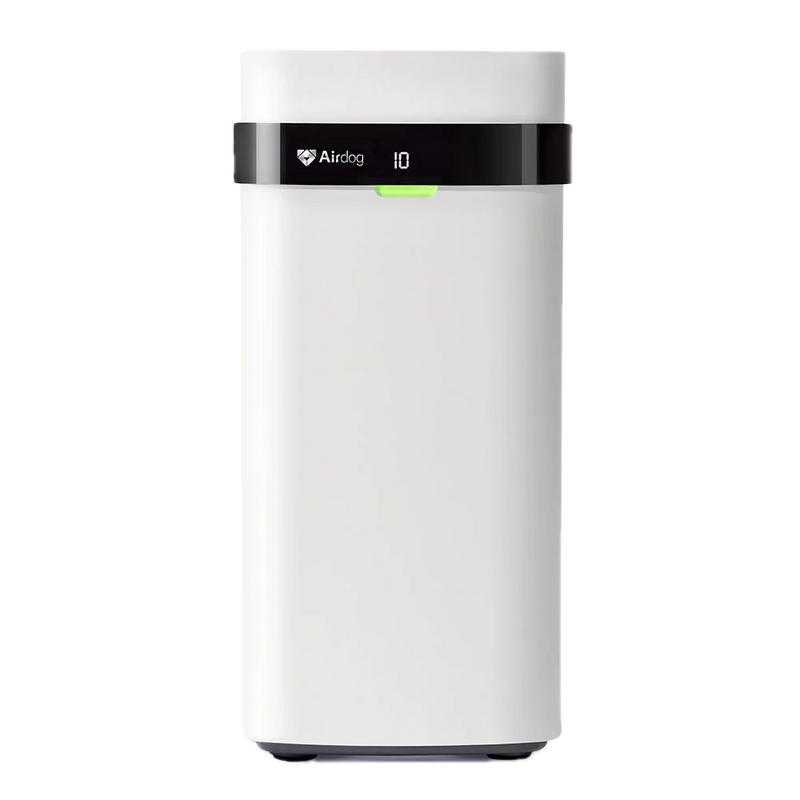
Airdog air purifiers use washable filters rather than disposable HEPA filters, eliminating the recurring cost and waste of replacement filters while maintaining high filtration efficiency. For families managing budgets and environmental impact, this approach delivers clean air without the subscription model many competitors require.
Increase Natural Ventilation
Natural ventilation costs nothing and works immediately. Opening windows when outdoor temperatures permit creates cross-ventilation that rapidly exchanges indoor air with fresh outdoor air. Even five to ten minutes of open windows can significantly reduce accumulated viral particles, particularly after someone coughs or sneezes indoors.
Run Exhaust Fans
Strategic use of exhaust fans accelerates air exchange in specific situations. Running bathroom fans during and after showers removes humid air that can help viral particles persist. Kitchen exhaust fans used during cooking also pull stale air out of your home, creating negative pressure that draws fresh air in through other openings.
Maintain Healthy Humidity
Humidity control plays a supporting role in air quality. Research on influenza transmission found that cold and dry conditions favor aerosol spread of the virus. Maintaining indoor relative humidity between 40-60% can reduce viral survival and transmission efficiency, though this benefit complements rather than replaces filtration and ventilation.
Additional Measures to Prevent Flu Spread
Air quality improvements work best as part of a comprehensive approach to flu prevention. Multiple defensive layers create redundancy—if one measure fails, others continue protecting your family.
-
Wash hands with soap and water for at least 20 seconds
-
Disinfect high-touch surfaces daily
-
Isolate sick household members when possible
-
Use masks for caregivers and sick individuals
-
Vaccinate annually for immune protection
The timing of interventions matters. Don't wait until someone in your household shows symptoms to implement these measures. Viral shedding begins before symptoms appear, meaning prevention must be proactive rather than reactive. Starting air purifiers, upgrading filters, and establishing hygiene routines before flu season arrives means your defenses are already in place when exposure occurs.
Understanding how the flu spreads through your home empowers you to take effective action. Clean air doesn't guarantee immunity, but it measurably reduces the viral load your family breathes, creating an environment where transmission becomes less likely with each passing hour. For mothers managing the health of children and elderly parents, these practical steps transform abstract worry into concrete protection.
Why Indoor Air Quality Matters More Than You Think During Flu Season
The air inside your home tells a story you can't see. Every breath your family takes during flu season could contain viral particles from an infected person—even someone who doesn't look or feel sick yet.
Indoor air concentrates respiratory viruses in ways outdoor air never does. When your child coughs in the living room, those viral particles don't simply disappear. They circulate through your HVAC system, settle on surfaces, and remain suspended in still air for hours.
CDC research confirms that respiratory viruses build up more indoors than outdoors. The reason is simple: outdoor air constantly dilutes and disperses viral particles through natural wind and atmospheric mixing. Indoor air, by contrast, recirculates the same particles unless you actively remove them.
Think about where your family spends most of their time during winter. Closed windows trap warmth—and trap airborne viruses with it. Your heating system cycles the same air repeatedly, potentially spreading one person's infection throughout the entire house.
The concentration effect becomes particularly dangerous in smaller rooms. A bedroom where a sick child sleeps accumulates viral particles overnight. A bathroom shared by family members becomes a transmission hotspot. Without adequate ventilation or filtration, these spaces maintain high viral loads that persist long after the infected person leaves.
This changes how you should think about protection. You can't simply avoid people who are actively coughing. An infected person breathing normally in your home for several hours releases enough virus into the air to create transmission risk.
Your home's air quality directly influences whether exposure leads to infection. High viral concentrations overwhelm immune defenses. Lower concentrations give your body a fighting chance to neutralize the virus before it replicates.
The Role of Clean Air in Reducing Flu Risk
Clean air acts as an invisible shield against influenza transmission in your home. The mechanism is straightforward: dilution reduces viral concentration in the air your family breathes.
When an infected person releases viral particles, those particles disperse throughout a room. Without adequate air cleaning, concentrations build up over time. With proper ventilation and filtration, fresh or filtered air continuously replaces contaminated air. Aim for at least five air changes per hour using a combination of:
-
Portable air purifiers add equivalent clean air delivery to any room
-
HVAC system upgrades using MERV 13 or higher filters improve whole-home filtration
-
Natural ventilation through open windows (when weather permits) introduces outdoor air
-
Combination strategies stack these methods for maximum air exchange
Continuous operation delivers better protection than intermittent use. Viral particles accumulate whenever an infected person occupies a space. Running air purification only when someone appears sick misses the crucial pre-symptomatic period when transmission already occurs. Viral shedding begins before symptoms appear, so air cleaning must be proactive, not reactive.
Final Thoughts: How the Flu Spreads and What You Can Do
The flu spreads through droplets, airborne aerosols, and contaminated surfaces. Indoor air quality plays a major role in how easily the virus moves through your home.
Clean air does not guarantee immunity, but it significantly reduces the viral load your family breathes. Improving ventilation, upgrading filtration, and maintaining healthy humidity levels all help lower exposure risk especially when combined with vaccination and good hygiene habits.
Many families choose to support cleaner indoor air with air purifiers designed for continuous use, including Airdog models with washable filtration systems, as part of a long-term strategy for healthier indoor environments.
For parents caring for children and elderly family members, these steps turn invisible air into a powerful layer of protection during flu season.