

Executive Summary:
This guide explains why most air purifier reviews measure the wrong things—and what to look for instead.
-
You'll learn why CADR and HEPA certification, the two standards behind almost every review and box claim, were built in the 1980s and don't measure viruses, bacteria, VOCs, or the ultrafine particles most linked to serious health effects
-
You'll learn what ultrafine particles are, why they make up 90% of all airborne particles by count, and why no amount of vacuuming or ventilation removes them
-
You'll learn how coverage claims are calculated—and why a purifier marketed for 1,600 sq ft may only meaningfully clean 400 sq ft of your home
-
You'll learn what happens to a HEPA filter after day one: how it loses efficiency, accumulates biological contamination, and may be worsening your air quality by the time you think to replace it
-
You'll learn how Airdog's TPA technology addresses each of these gaps—filtering down to 0.0146 microns, destroying biological contaminants on contact, and eliminating VOCs rather than storing them
-
You'll learn the true five-year cost of running an air purifier, including what replacement filters actually add up to over time
By the end, you'll have a more complete picture of indoor air quality than most consumers—or most publications—ever get.
Which air purifier should you buy? With dozens of brands and hundreds of products on the market—each with impressive claims—it can be difficult to compare, contrast, and ultimately purchase the right air purifier for you.
We created this guide to assist you in your decision-making process as you seek to improve your life through cleaner air.
Criteria Reality Check: Why Differentiating Air Purifiers is Difficult
The primary standard used to compare air purifiers—the CADR score—was developed in the early 1980s for the air quality problems and technologies of that era. It measures how quickly a brand-new unit removes tobacco smoke, dust, and pollen from a test chamber at maximum fan speed.
The world has changed. We now spend roughly 90% of our lives indoors. COVID-19 permanently changed our understanding of how viruses travel through shared air. And the modern home is full of harmful Volatile Organic Compounds (VOCs)—silently off-gassing from furniture, flooring, paints, and cleaning products around the clock.
The CADR framework wasn't built for any of this. It doesn't measure viruses, bacteria, VOCs, formaldehyde, or ultrafine particles. It says nothing about month-six performance, or whether a technology captures and destroys contaminants or simply stores them. Even the most rigorous consumer publications test within this same particle-focused framework—which consistently favors technologies it was built around, while underrepresenting those that perform better on the metrics it doesn't test.
The industry air quality measurement standard does not measure viruses, bacteria, VOCs, formaldehyde, or ultrafine particles.
This guide asks four questions instead:
-
Performance: Does it clean the full spectrum of what's in your air—not just what a 40-year-old test measures?
-
Safety: Is it safe to run continuously in an occupied home?
-
Longevity: Does it stay effective over time, or degrade in ways the day-one score doesn't predict?
-
True Cost: What does it actually cost over 3–5 years of ownership?
Each section answers one of these questions using published research, independent testing standards, and third-party data.
Performance
Does it actually clean the air you breathe? What Are You Even Cleaning?
Not all airborne particles are the same size—and size determines everything: where a particle comes from, where it ends up in your body, and how much damage it can do once it's there.
Scientists categorize airborne particles into three tiers:
- PM10 — particles 10 microns and larger. Dust, pollen, ash, pet dander. Your nose, throat, and upper airways catch most of these naturally. They cause irritation but rarely penetrate deep enough to create systemic health problems.
- PM2.5 — particles up to 2.5 microns, including exhaust, heavy metals, and combustion byproducts. Small enough to bypass your upper airway defenses entirely and lodge deep in lung tissue. Long-term PM2.5 exposure is linked to cardiovascular disease, lung disease, and premature death—which is why it's the EPA's primary outdoor air quality benchmark.
- PM0.1 (Ultrafine) — particles smaller than 0.1 microns. Viruses, bacteria, VOCs, and combustion byproducts. These are the most dangerous tier. Small enough to cross directly from your lungs into your bloodstream, ultrafine particles can reach your heart, brain, and other organs. They're associated with cardiovascular inflammation, cognitive decline, and systemic health effects well beyond the respiratory system. Because they're so light, they don't settle—they stay suspended in indoor air indefinitely, meaning continuous exposure as long as they're present.
[Diagram 1: Particle size spectrum with example contaminants at each tier; HEPA effective range bracketed; Airdog effective range bracketed]
HEPA filtration—the technology behind most air purifiers on the market—is certified to capture particles down to 0.3 microns. That covers PM10 and most of PM2.5. It does not reach ultrafine.
Here's why that matters:
[Diagram 2: Same spectrum; PM0.1 labeled as 90% of all airborne particles by count]
Ultrafine particles—the most harmful tier and the one HEPA doesn't reach—make up approximately 90% of all airborne particles by count. They're also the ones that never settle on their own, meaning no amount of cleaning or ventilation removes them the way it does larger particles.
This isn't a minor gap in coverage. It's the majority of what's in your air.
The CADR Problem
CADR—Clean Air Delivery Rate—is the number printed on every air purifier box and cited in almost every review. It measures how quickly a unit cleans a room of smoke, dust, and pollen. A higher number means faster cleaning. It's a useful comparison tool as far as it goes.
It doesn't go far enough—and that's not a coincidence.
CADR was developed alongside HEPA filtration. HEPA's certified benchmark is 0.3 microns—the particle size that is hardest for mechanical fiber filters to capture. CADR was built to measure what HEPA was built to do. The two standards were designed for each other, which is why they've stayed together for four decades and why review sites that test CADR almost always evaluate HEPA purifiers specifically.
The problem is that 0.3 microns isn't the finish line—it's roughly where the ultrafine category begins. A purifier can earn a perfect CADR score and a True HEPA certification and still do nothing about the particles most likely to enter your bloodstream.
That's not a flaw in one brand's product. It's a flaw in the measuring stick the entire industry uses.
Room Coverage: What the Numbers Actually Mean
Every air purifier lists a recommended room size. What most brands don't tell you is how that number was calculated.
Air Changes per Hour (ACH) measures how many times per hour an air purifier cycles the entire volume of air in a room through its filtration system. One ACH means every molecule of air in the room passes through the purifier once every 60 minutes. Four ACH means it passes through four times every 60 minutes.
The industry calculates coverage claims at 1 ACH. Not because it's the most meaningful measure of air quality improvement—but because it produces the largest possible room size number. A purifier that genuinely covers 400 sq ft can be marketed as covering 1,600 sq ft simply by changing the ACH assumption. Every major brand does this.
The EPA and most air quality researchers recommend a minimum of 4 ACH for meaningful air quality improvement. Here's what that means in practice:
|
Room Type |
Typical Size |
Purifier Rated at 1 ACH (industry standard) |
Purifier rated at 4 ACH (health-recommended) |
|
Bedroom / Home Office |
~200 sq ft |
200 sq ft |
800 sq ft |
|
Living Room |
~400 sq ft |
400 sq ft |
1,600 sq ft |
|
Open Floor Plan |
~1,000 sq ft |
1,000 sq ft |
4,000 sq ft |
|
Large Commercial Space |
~2,500 sq ft |
2,500 sq ft |
10,000 sq ft |
When comparing any air purifier's coverage claim, always ask which ACH number it's based on. Any brand worth trusting will show you both.
How Airdog Performs Across the Full Spectrum
This guide is published by Airdog but the particle size research is real, the CADR limitations are documented, and the ACH math is straightforward arithmetic regardless of who's presenting it. We're introducing ourselves here because this is where the technology comparison becomes relevant.
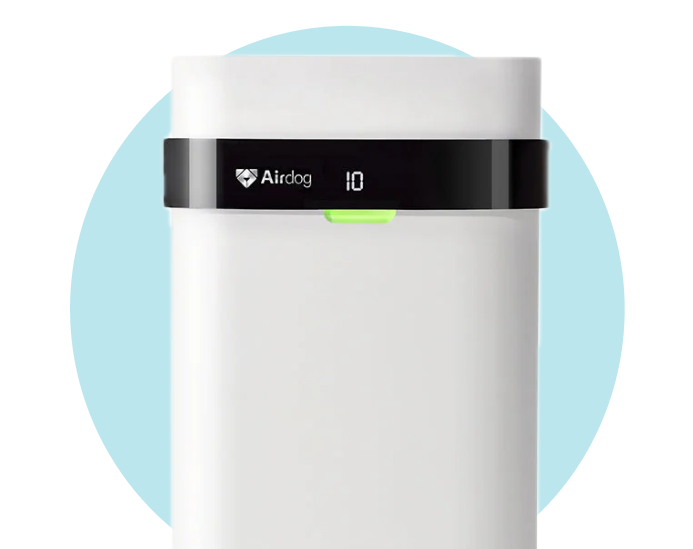
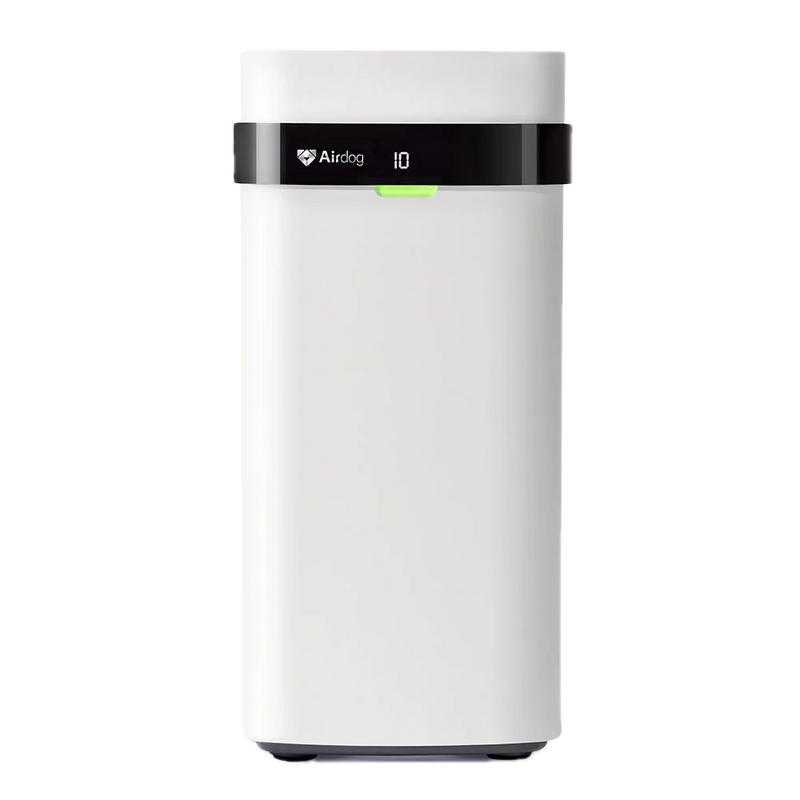
Airdog uses a patented technology called TPA®—Two-Pole Active filtration.
Rather than forcing air through a physical fiber mesh like HEPA, TPA generates a high-voltage electric field that actively electrifies incoming particles. Those charged particles are then attracted and collected on collecting plates. The microbio pollutants are destroyed on washable collecting plates. TPA doesn't just capture contaminants like a HEPA filter, it terminates them.
This matters across three dimensions:
- Filtration range. TPA filters particles down to 0.0146 microns—deep into the ultrafine category that HEPA doesn't reach, covering the viruses, bacteria, and combustion byproducts that make up 90% of airborne particles by count.
- VOC and gas-phase elimination. Most air purifiers treat VOCs as an afterthought—a thin activated carbon layer that saturates within weeks. Airdog addresses VOCs in two stages. First, TPA's high-voltage field generates a cold plasma effect that breaks down the chemical bonds of VOCs and gaseous pollutants directly. Second, air passes through a catalytic composite and activated carbon layer that absorbs remaining vapors and odors. The result: 99.9% formaldehyde removal in independent SGS laboratory testing—one of the most rigorous third-party certification bodies in the world.
- Biological safety. Because TPA destroys particles rather than storing them, there is no biological accumulation between cleanings—no live mold, no bacteria, no mycotoxins re-releasing into your air. We'll cover this in depth in the next section.
Maintenance. Collection plates and filters wash clean with soap and warm water—or a dishwasher cycle. No replacement filters. Performance restores to baseline after every wash.
Safety
Does it create new problems while solving old ones? The Biological Hotbed Problem
This is the safety issue no one in the industry talks about—and it's the one most likely to affect you.
HEPA filters capture contaminants mechanically. The fibers trap particles and hold them. That sounds like the right outcome—until you consider what happens next.
HEPA filters don't kill what they catch. Bacteria, mold spores, and other biological contaminants captured on a HEPA filter remain viable. Under normal household humidity conditions, those organisms can survive, reproduce, and re-release back into the airstream passing through the filter. The device designed to clean your air becomes a continuous source of biological contamination.
Peer-reviewed research has documented this directly. A study published in Scientific Reports (Nature) found that viable bacteria concentrations on used HEPA filters were significantly higher than in the floor dust of the same rooms—meaning the filter had actively concentrated and incubated microbial life. Identified species in used filters have included Aspergillus niger, Cladosporium, Penicillium, and Alternaria—all recognized respiratory allergens.
[Diagram showing HEPA next to TPA with the HEPA filter accruing more bacteria over time and TPA neutralizing/destroying it.]
The problem compounds over time. Mold colonies growing inside a filter produce mycotoxins—chemical byproducts often below 0.1 microns in size. They pass straight through the HEPA filter even after the spore that produced them was captured.
A filter that hasn't been replaced on schedule isn't just underperforming. It may be actively worsening your air quality.
How Airdog handles this: TPA's high voltage destroys biological contaminants on contact rather than storing them. There is no accumulation between cleanings, no viable organisms incubating on collection plates, and no mycotoxin re-emission risk. Washing the plates removes debris entirely—the biological slate is wiped clean with every maintenance cycle.
Ozone: Know What You're Running in Your Home
Ozone is a molecule made of three oxygen atoms (O₃). In the upper atmosphere, it blocks UV radiation—that's the "ozone layer" you've heard about. At ground level, inside your home, it's a different story entirely: ozone is a lung irritant and a regulated air pollutant.
Short-term exposure causes coughing, chest tightness, and shortness of breath. Long-term exposure is linked to permanent lung damage and increased cardiovascular risk. The American Lung Association has stated that even low ozone levels increase the risk of premature death.
Some air purification technologies produce ozone as a direct byproduct of operation. Some manufacturers market ozone as "activated oxygen" or "energized air." It isn't. It's a pollutant.
The regulatory limit is 50 parts per billion (PPB), set by both the EPA and California's Air Resources Board (CARB). ASHRAE recommends staying below 10 PPB for continuously occupied spaces. Those are meaningfully different numbers—and the gap between them matters when a device is running 24 hours a day in a bedroom.
Ozone output by technology:
|
Technology |
Ozone Output |
|
HEPA (mechanical only) |
None |
|
Airdog TPA® |
Trace amounts, fully neutralized by the catalytic filter stage—net output CARB certified below 50 PPB |
|
Standard Ionizer |
Moderate to high—check for CARB certification |
|
UV-C (properly shielded) |
Minimal |
When evaluating any air purifier that uses electronic technology—ionizers, electrostatic precipitators, UV, or plasma—CARB certification should be a non-negotiable requirement.
Ionizers produce ozone as a byproduct of their ionization process. Some also cause ultrafine particles to nucleate—forming new particles rather than removing existing ones. CARB certification is essential before purchasing any ionizer.
UV-C can inactivate biological contaminants but requires sufficient exposure time and proper shielding. Most consumer-grade UV purifiers move air too quickly through the UV chamber for meaningful inactivation. Improperly shielded UV-C also poses a direct eye and skin hazard.
EMF emissions from air purifiers are generally minimal and comparable to other household appliances. Airdog's electric field operates entirely within the unit's internal chamber and does not radiate outward.
A note on electric shock: Some customers ask whether Airdog's high-voltage TPA field poses an electric shock risk. It doesn't. The electric field operates entirely within a sealed internal chamber during normal use. Collection plates only carry a charge while the unit is running—and the unit should always be powered off before cleaning. Standard handling during a wash cycle carries no shock risk.
Longevity
Does it stay effective—or get worse over time? How HEPA Performance Degrades
Every air purifier is tested on its best day—new filter, clean unit, controlled lab environment. What manufacturers don't publish is what happens after that.
HEPA filters degrade through three distinct mechanisms:
- Airflow restriction. Captured particles clog the filter over time, reducing airflow and CADR progressively from day one. [Placeholder: cite German study showing 4x CADR decline]
- Electret charge loss. Many HEPA filters rely partly on an electrostatic charge to meet their rated efficiency—not fiber density alone. That charge dissipates through normal heat and humidity exposure, often within weeks, with no visible indicator that performance has dropped.
- Biological loading. As covered in the Safety section, biological contaminants accumulate and colonize the filter over time, compounding both airflow restriction and contamination risk simultaneously.
A filter operating under all three mechanisms isn't just underperforming—it may be actively working against you.
What Maintenance Actually Restores
HEPA: Replacing a filter restores airflow and removes biological buildup. It does not restore electret charge—replacement filters begin their own charge dissipation cycle immediately. The performance ceiling resets, but the clock starts over.
The bigger problem is the gap. Manufacturer replacement intervals are typically 6–12 months. Most users replace less frequently than that. Every month past the recommended interval is a month of degraded—and potentially counterproductive—performance.
Airdog TPA: Washing the collection plates removes captured debris entirely and restores the unit to operational baseline. The electric field is generated by the unit's electronics, not embedded in a consumable medium—so it doesn't degrade between washes the way electret charge does.
[Placeholder: third-party pre/post-wash performance data showing CADR restoration to baseline]
The practical difference: HEPA's best performance is day one. Airdog's best performance is after every wash.
Build Quality and What It Signals
An air purifier runs continuously, often for years. Build quality determines whether the performance you bought on day one is still available in year three.
Collection and filtration materials. Airdog's collection plates are stainless steel and aluminum—non-porous, washable, dimensionally stable. Plastic internal components in lower-cost units can off-gas VOCs under continuous heat load and warp over time, affecting airflow paths and seal integrity.
Housing tolerances. A unit with loose housing tolerances allows air to bypass the filtration stage entirely—common in lower-cost HEPA units where the filter sits in a loosely fitted plastic frame.
Warranty. Check whether any warranty covers the filtration mechanism itself or only the motor and housing—a common distinction that matters significantly for long-term value.
True Cost
What are you really paying? The Number on the Box Isn't the Price
The sticker price of an air purifier is the least important number in the purchase decision—especially for a device you'll run 24 hours a day for years.
The real cost is the sum of four components: purchase price, filter or maintenance consumables, energy consumption, and replacement unit costs if the device fails. Evaluated separately, each looks manageable. Evaluated together over five years, the gaps between technologies become significant.
The Filter Replacement Trap
HEPA filters require replacement every 6–12 months depending on the manufacturer and usage environment. Most households replace on the longer end of that interval—or later.
Replacement filter costs vary widely, but premium HEPA units routinely price replacement filters at $40–$80 per filter, per unit, per year. Multi-stage systems (HEPA + carbon pre-filter + activated carbon layer) can run significantly higher. That cost is recurring, mandatory, and permanent for the life of the device.
|
Cost Component |
HEPA (Annual) |
Airdog TPA (Annual) |
|
Filter Replacements |
$[placeholder] |
$0 |
|
Energy consumption |
$[placeholder] |
$[placeholder] |
|
Total annual operating cost |
$[placeholder] |
$[placeholder] |
[Placeholder: populate with actual filter replacement costs for 2–3 major HEPA competitors and Airdog model energy draw at typical usage]
Five-Year Total Cost of Ownership
|
HEPA-Based Purifier |
Airdog Air Purifier |
|
|
Purchase price |
$[placeholder] |
$[placeholder] |
|
Filter costs (5 years) |
$[placeholder] |
$0 |
|
Energy costs (5 years) |
$[placeholder] |
$[placeholder] |
|
5-Year TCO |
$[placeholder] |
$[placeholder] |
[Placeholder: complete table once model pricing, competitor filter costs, and energy draw data are confirmed]
The purchase price gap between a premium HEPA unit and an Airdog typically narrows significantly within the first two years of ownership. By year five, the TCO advantage generally favors Airdog—even before accounting for the performance degradation that makes HEPA filter replacement non-optional.
Cost Per Clean Air Delivered
Purchase price and operating cost tell you what you're spending. They don't tell you what you're getting for it.
A more useful metric: cost per unit of actual clean air delivered, accounting for real-world performance degradation over time.
A HEPA unit operating at declining efficiency through the back half of its filter cycle is spending your money to move air it's no longer meaningfully cleaning. The effective CADR—and therefore the cost per unit of clean air—worsens progressively between replacements.
Airdog's washable plate system restores performance to baseline on each cleaning cycle. The cost per unit of clean air remains consistent across the life of the device.
[Placeholder: insert cost-per-CADR calculation once performance data and pricing are confirmed]
Deep-Dive Comparison
A full side-by-side comparison
Performance
|
HEPA + Carbon |
HEPA + Carbon + UV-C |
Standalone Ionizer |
Airdog TPA |
|
|
Particle filtration range |
Down to 0.3μm |
Down to 0.3μm |
Variable—no mechanical filtration |
Down to 0.0146μm |
|
Ultrafine particle capture |
No |
No |
Partial—charges but doesn't capture |
Yes |
|
VOC / formaldehyde removal |
Partial—carbon saturates over time |
Partial—carbon saturates over time |
No |
Yes—cold plasma breaks chemical bonds |
|
Virus / bacteria inactivation |
No—captures only |
Partial—UV-C exposure time typically insufficient at consumer airflow speeds |
Partial |
Yes—electric field destroys on contact |
|
Real-world CADR consistency |
Declines over filter life |
Declines over filter life |
Unreliable |
Restores to baseline after each wash |
|
Auto-mode / adaptive operation |
Varies by model |
Varies by model |
Rarely |
Yes—built-in AQI sensor adjusts output automatically |
|
Coverage accuracy |
Often overstated (1 ACH basis) |
Often overstated (1 ACH basis) |
Unreliable |
[Placeholder: insert verified ACH-adjusted coverage by model] |
Safety
|
|
HEPA + Carbon |
HEPA + Carbon + UV-C |
Standalone Ionizer |
Airdog TPA |
|
Ozone output |
None |
Minimal if UV-C properly shielded—verify before buying |
Moderate to high |
Trace—neutralized by catalytic filter; CARB certified |
|
CARB certified |
N/A |
Check before buying |
Check before buying—many fail |
Yes |
|
Biological hotbed risk |
Yes—captured organisms remain viable on filter |
Yes—UV-C stage rarely eliminates hotbed risk entirely |
No |
No—electric field destroys on contact |
|
Mycotoxin re-emission risk |
Yes |
Yes |
No |
No |
|
Secondary particle generation |
No |
No |
Possible—ionizers can nucleate new ultrafine particles |
No |
Longevity
HEPA + Carbon |
HEPA + Carbon + UV-C |
Standalone Ionizer |
Airdog TPA |
|
Performance over time |
Degrades continuously from day one |
Degrades continuously from day one |
Variable—no filter to clog but no consistent mechanism |
Restores to baseline after each wash |
Electret charge loss |
Affects many HEPA filters—no visible indicator |
Affects many HEPA filters—no visible indicator |
N/A |
N/A |
Carbon saturation |
Yes—re-emits captured VOCs once saturated |
Yes—re-emits captured VOCs once saturated |
N/A |
No—VOCs broken down, not stored |
Maintenance restores baseline |
No—replacement resets clock but charge dissipates immediately |
No—replacement resets clock but charge dissipates immediately |
Varies |
Yes |
Consumable lifespan |
HEPA: 6–12 months / Carbon: 3–6 months |
HEPA: 6–12 months / Carbon: 3–6 months / UV lamp: 1–2 years |
Minimal |
Washable plates—no replacement required |
Build materials |
Plastic housing, fiber filter |
Plastic housing, fiber filter |
Plastic |
Stainless steel and aluminum collection plates |
True Cost (5-Year)
HEPA + Carbon |
HEPA + Carbon + UV-C |
Standalone Ionizer |
Airdog TPA |
|
Average purchase price |
$[placeholder] |
$[placeholder] |
$[placeholder] |
$[placeholder] |
Annual consumable cost |
$[placeholder] |
$[placeholder] |
Minimal |
$0 |
5-year consumable cost |
$[placeholder] |
$[placeholder] |
$[placeholder] |
$0 |
Annual energy cost |
$[placeholder] |
$[placeholder] |
$[placeholder] |
$[placeholder] |
5-Year TCO |
$[placeholder] |
$[placeholder] |
$[placeholder] |
$[placeholder] |
Cost-per-CADR (year 1) |
$[placeholder] |
$[placeholder] |
N/A |
$[placeholder] |
Cost-per-CADR (year 3) |
$[placeholder—reflects degradation] |
$[placeholder—reflects degradation] |
N/A |
$[placeholder—stable] |
Environmental Impact
HEPA + Carbon |
HEPA + Carbon + UV-C |
Standalone Ionizer |
Airdog TPA |
|
Consumable waste |
Non-recyclable HEPA + carbon filter every 6–12 months—approx. [X] plastic grocery bags of waste per filter |
Non-recyclable HEPA + carbon filter + UV lamp disposal (mercury risk in some models) |
Minimal |
None—washable plates produce no consumable waste |
Recyclability |
Filter: no. Housing: partial. |
Filter: no. Lamp: hazardous waste. Housing: partial. |
Partial |
Plates: yes. Housing: partial. |
Long-term landfill contribution |
High—continuous over device life |
High + hazardous lamp waste |
Low |
None |
Manufacturing footprint |
Ongoing—new consumables manufactured every replacement cycle |
Ongoing—new consumables manufactured every replacement cycle |
Low |
None after initial purchase |
On HEPA and landfill waste: Every HEPA filter ends up in a landfill—non-recyclable and contaminated with everything it captured. Over five years, the average HEPA household disposes of 5–10 filters. At approximately [X] plastic grocery bags of waste equivalent per filter, the environmental cost of "clean air" compounds quickly. Airdog's washable plates produce zero consumable waste over the life of the device.
Conclusion
The air purifier you choose matters more than the industry wants you to know.
The standards used to evaluate air purifiers were built in the 1980s for a technology that made sense then. CADR measures what HEPA does. HEPA certification benchmarks at 0.3 microns. The industry built its measuring stick around its own product—and then used that stick to evaluate everything that came after.
What that framework doesn't measure: the ultrafine particles that cross the lung-blood barrier. The biological colonies growing inside filters between replacements. The VOCs a saturated carbon filter re-emits into the room it was supposed to protect. The performance gap between day one and month eleven.
You now have a more complete picture than most consumers—and most publications—ever get.
Who Airdog is built for
If any of these describe you, Airdog TPA is worth a serious look:
-
You have kids, pets, or a family member with asthma, allergies, or a respiratory condition
-
You care about what's actually in your air—not just whether a filter met a 1980s benchmark
-
You're tired of recurring filter costs and want a device that performs consistently for years
-
You want to set it, forget it, and trust that the air quality sensor is doing its job
-
You want clean air without adding to a landfill every six months