

Before you buy a humidifier for dogs, you need to know whether your home actually has a humidity problem.
Start by measuring your home’s humidity with a basic hygrometer. This small sensor reads the percentage of moisture in your air and costs less than most dog toys. Place it in the room where your dog spends most of their time, checking the reading over several days.
A humidifier isn't necessary if your hygrometer consistently shows 40–50% and your dog isn't scratching or snoring excessively.
If you suspect that your dog is suffering from dry air, you should be able to detect a pattern of symptoms. Recurring dry or scabbed nose often signals that indoor air is pulling moisture from your dog's sensitive nasal tissue. Mild congestion that worsens at night—when your dog spends hours in a closed bedroom with the heat running—suggests the same issue.
Increased snoring can result from dried-out nasal passages and throat tissue. Winter itch and flaking skin that wasn't present in warmer months points directly to seasonal humidity drops caused by heating systems.
A dull, brittle coat texture often accompanies low indoor humidity because dry air strips natural oils from fur and skin.
Increased shedding that spikes when the furnace runs may indicate that your dog's skin barrier is struggling to maintain moisture balance.
Don't assume humidity is always the cause
Responsible pet ownership means ruling out more serious issues first. If your dog's itching is intense, localized to specific spots, or paired with redness and odor, you're likely dealing with parasites, infection, or allergies rather than dry air.
A humidifier for dogs provides supportive comfort and is not a cure for medical conditions. Schedule a vet visit if symptoms persist despite humidity adjustments or if you notice any signs of skin infection or illness.
Signs that you may just need better ventilation
A musty smell or consistently damp-feeling rooms means your home already has too much humidity. In this case, adding more moisture would worsen your dog's comfort rather than improve it.
High humidity increases overheating risk because dogs rely on evaporative cooling through panting. Excessive moisture can also worsen respiratory stress, particularly in flat-faced breeds already prone to breathing difficulties.
If your hygrometer reads above 60% consistently, you need dehumidification and better ventilation—not a humidifier.
Choosing the safest humidifier for dogs
Choose a cool-mist humidifier for any home with dogs.
Warm-mist humidifiers boil water to create steam. That means the water inside reaches temperatures hot enough to cause serious burns. If a curious dog bumps or knocks over a warm-mist unit, they can suffer painful burns from the hot water or steam.
Cool-mist humidifiers produce room-temperature vapor. No boiling water, no scalding steam, no burn risk if your dog gets too close during an investigation.
Place away from electronics and other hazards
A tipped-over humidifier near an electrical outlet creates a shock risk for your pet.
Look for units with a wide, stable base that won't tip easily. Check that the water tank locks securely into place rather than sitting loosely on top of the base.
Cord management matters just as much. Choose models with shorter cords or built-in cord storage. Place the unit where the power cord runs along the wall rather than across walkways where paws can catch it.
Position your humidifier away from high-traffic zones and dog play areas. Behind furniture with airflow clearance works well.
Must-have’s for a humidifier for dogs
A built-in humidistat should top your must-have list. This feature automatically maintains your target humidity percentage without constant manual adjustments.
Set it to 45%, and the unit stops producing mist once the room reaches that level. No risk of over-humidifying, no need to monitor constantly, no condensation problems from pushing moisture too high.
Easy-to-clean tank design saves time and prevents maintenance failures. Look for wide-mouth openings that let you reach inside with a cloth or sponge. Tanks with smooth interiors clean faster than those with grooves or complicated shapes.
Look for units with quiet mode or noise ratings below 35 decibels. That's roughly equivalent to a whisper or soft library environment.
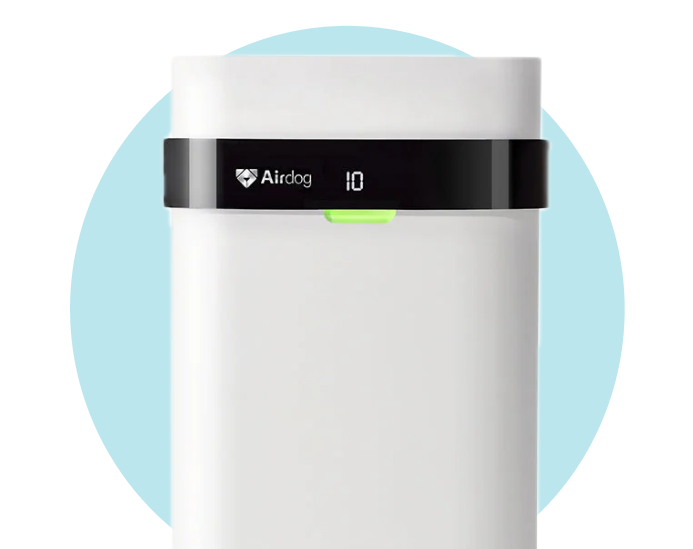
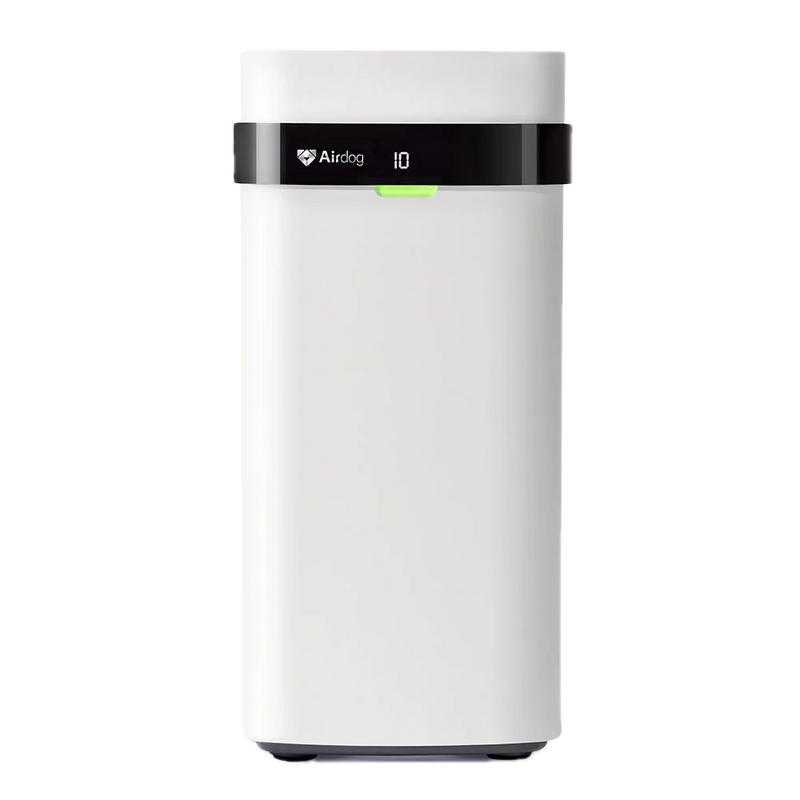
An excellent choice for dog owners is the Airdog MOI Mold-Free Evaporative Humidifier.
The Airdog MOI’s Smart Mode keeps humidity at the perfect level for your and your dog’s comfort, and its wide base helps to prevent accidental spills when your pup gets excited.
The mold-free evaporative humidification system produces uniform humidification without any of the mist or hassle of ultrasonic humidifiers.
Learn more or begin your risk-free 30-day at-home trial here.
What to avoid: the firm "no" list for dog households
Skip essential oils and fragrance add-ons entirely. Many humidifiers advertise compatibility with scented oils or aromatherapy trays.
Dogs have sensitive airways. What smells pleasant to humans can irritate a dog's respiratory system. The safest approach is to use pure water only, nothing added.
Don't assume medicated vapor products are dog-safe just because they're marketed for human colds. Products containing menthol, eucalyptus, or camphor can cause respiratory distress in dogs.
Avoid units that require proprietary cleaning solutions or special water treatments. These add cost, create dependency on specific products, and introduce chemicals into the air your dog breathes.
Set the right humidity target
Aim for 40–50% relative humidity as your baseline target when running a humidifier for dogs. Condensation on your windows indicates that you have over-humidified the space and need to dial back.
Bulldogs, Pugs, French Bulldogs, and other brachycephalic dogs struggle more with heat exchange and labored breathing when humidity climbs too high.
Their shortened airways already make breathing harder. Add excessive moisture to the air, and their bodies work even harder to cool down through panting—their primary temperature regulation method.
Stay toward the lower end of the recommended range for flat-faced dogs—closer to 35–45% rather than pushing toward 50–60%.
Pair your humidifier strategy with good airflow. Run ceiling fans on low, position beds away from heat vents, and ensure your dog has access to cooler spots in your home. A humidifier for dogs with short noses works best when combined with temperature and airflow management.
Your decision tree for using a humidifier for dogs
Start with measurement. Use a hygrometer to check current humidity levels in the room where your dog spends most time.
Pick your target range. Aim for 40–50% as your starting point, adjusting based on your dog's comfort and any condensation signals.
Try a cool-mist humidifier with safe placement. Position it elevated, stable, and away from where your dog can knock it over or investigate too closely.
Track symptoms for seven days. Note scratching frequency, breathing ease, snoring volume, and humidity readings each day.
Continue if symptoms improve. Keep running the humidifier as long as readings stay in range and your dog shows measurable comfort gains.
Stop or adjust if humidity overshoots. If readings climb above 55% or condensation appears, reduce settings or pause use entirely.
Involve a vet for significant respiratory distress or ongoing skin issues. Persistent symptoms need professional assessment. Humidity supports comfort but doesn't replace medical care.