

Dog preferences for fans vary wildly. Some dogs become "fan campers"—choosing to lie right in front of airflow—while others avoid it completely or show stress signals.
Signals that indicate your dog enjoys the fan:
-
Voluntarily lying in the airstream and staying there
-
Repositioning to keep airflow on face or chest
-
Settling faster after play or walks
-
Seeking out the fan zone repeatedly throughout the day
Signals that indicate your dog dislikes the fan:
-
Leaving the room when the fan turns on
-
Lip-licking combined with tense posture
-
Actively avoiding the fan's direction
-
Barking at ceiling fans
Based on what you observe, make two comfort tweaks. If your dog likes airflow but seems overwhelmed by intensity, aim the fan to skim across the room—indirect airflow—or use the oscillation setting. If they dislike airflow on the face (which can feel invasive to some dogs), angle the fan low so it cools the body area without blasting eyes or ears.
Do Fans Actually Cool Dogs?
A fan doesn't "make air colder"; it increases convection (heat transfer from skin to air) and boosts evaporation. This matters because dogs don't sweat like humans, so the cooling effect can be substantially smaller.
A fan can help a dog in two specific ways. First, increased airflow over the body enhances convection, allowing heat to transfer from the dog's skin to the surrounding air more efficiently. Second, moving air makes panting more effective because evaporation from the tongue and airways works better when fresh air constantly replaces the humid air near the dog's mouth.
NHPR explains that "panting works, in part, because of evaporation. That's why dogs dangle their tongue out into the air—it's a big, floppy, slimy heat sink that is evaporating saliva, and all of that open-mouth panting is more powerful when you have air blowing over it."
Temperature matters enormously. A fan might keep your dog more comfortable if temperatures are in the 70s or 80s. But when temperatures are in the upper 90s or the 100s, a fan just blows hot air around. This isn’t safe for your dog.
For warm-but-not-extreme days, use this "best-use" setup:
-
Place the fan near your dog's preferred resting spot
-
Provide unlimited access to fresh water
-
Pair the fan with a cool surface such as tile since many dogs naturally seek bare floors to increase airflow around their body
Note that if your dog chooses the fan, that's a preference signal. It is not proof that they're fully safe from overheating. You still need to monitor heat stress signs, watch for excessive panting at rest, and have a backup plan when temperatures climb beyond the fan's effective range.
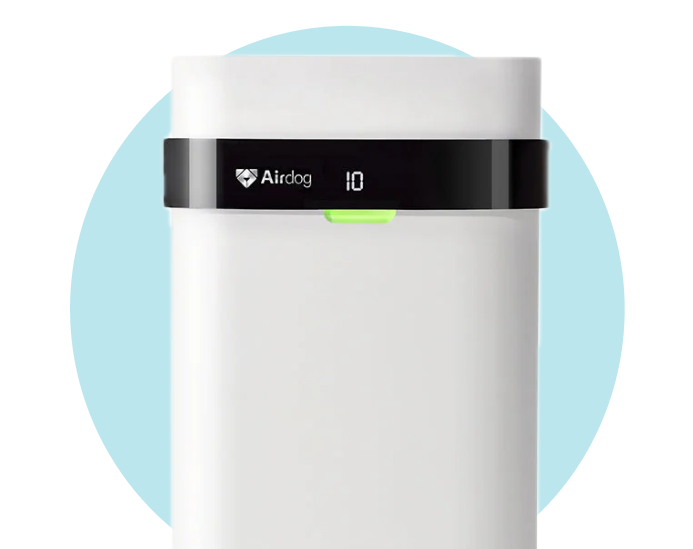
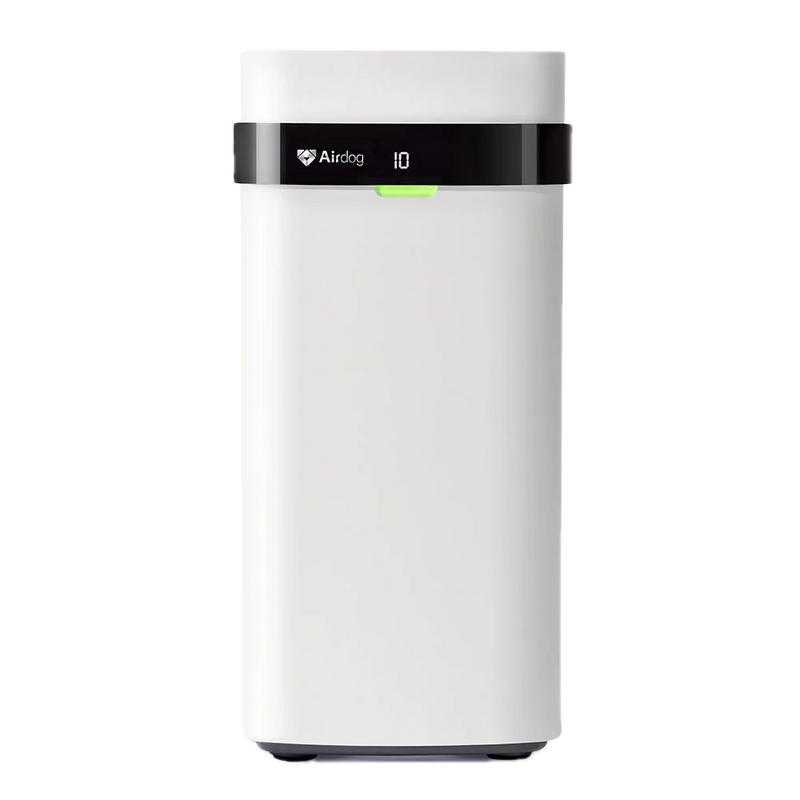
Airdog’s Smart Circulating Fan
Airdog’s Smart Circulating Fan is an excellent choice for keeping you and your dog cool.
While most fans only have sixty degrees of oscillation with 3-5 speeds, Airdog’s fan is customizable with 12 speeds; three height positions; and 60°+90°+120° oscillation both up-and-down and side-to-side.
The smart temperature setting automatically adjusts airflow based on set temperature triggers to keep your space comfortable, and negative ion purification cleans stale and dirty air.
Learn more about Airdog’s fan here, and put your money towards a unit that will actually make a difference for you and your dog during hot summer months.