





Air Purifiers for Kitchens
Cooking is one of the most significant sources of indoor air pollution in any home, generating fine particulates, volatile organic compounds, and odors that range from dinner-table pleasant to genuinely harmful. Airdog kitchen air purifiers are built to keep the room where you prepare your food as clean as the food itself.
Airdog's Best Air Purifiers for Kitchen Odors


Cleaner Air Has Never Been This Easy

1 Year Warranty
365-nights backed by safety + comfort

Pay as you go
Buy-now, pay-later financing @ 0% APR

Fast, Free Shipping
2-5 day shipping in the continental US

30-Day Home Trial
The best air you've ever had, guaranteed

24-hour Customer Service
Real, US-based customer support

How Do Air Purifiers Help in Kitchens?
What Cooking Actually Puts in the Air
Every time you cook, you introduce a complex mix of airborne compounds into your home. High-heat cooking such as searing, frying, and roasting releases fine particulate matter (PM2.5) at concentrations that can temporarily exceed outdoor air quality standards in major cities. Gas stoves add nitrogen dioxide to this mix. Even lower-heat methods like boiling and steaming release humidity and VOCs. Airdog's TPA® technology captures these particles down to 0.0146 microns, addressing the fine end of the combustion spectrum that standard range hoods are not designed to handle.
Beyond the Range Hood
Range hoods are designed to evacuate large volumes of smoke and steam directly upward; they are not particle filters. Many recirculating hoods simply push air through a grease filter and return it to the room with fine particulates intact. An Airdog kitchen air purifier works in parallel with your hood: while the hood handles visible smoke and bulk steam, the purifier captures the ultrafine particles and VOCs.
Placed near the cooking area but out of direct smoke flow, Airdog purifiers create a continuous capture field that processes kitchen air throughout and after cooking.
Air Purifiers
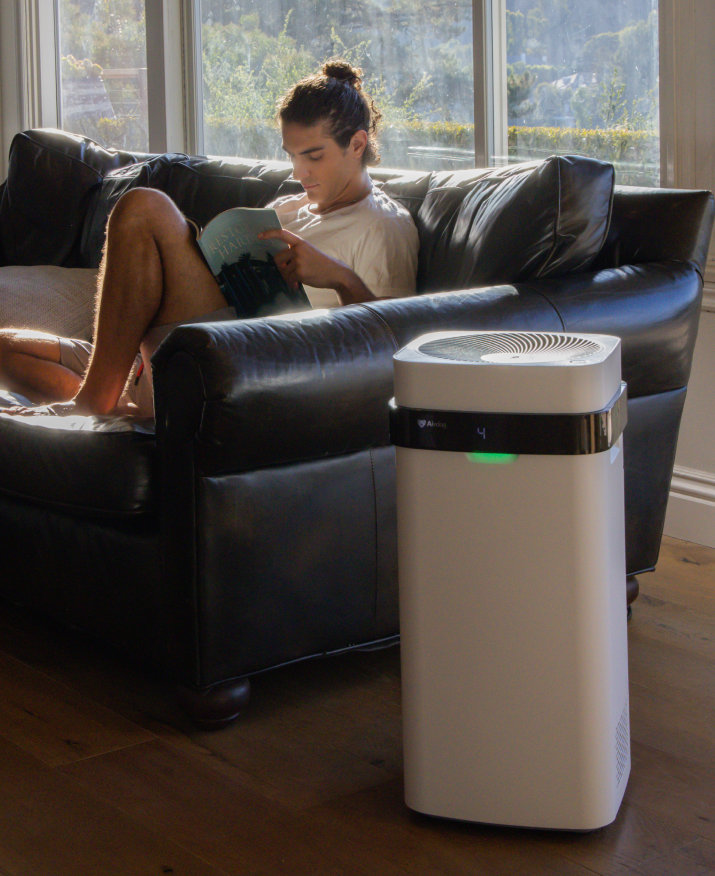
Airdog engineers the most reliable, most effective air purifiers in the world with a unit designed for every space.
Find the right purifiers your offices, your family spaces, bedrooms and more.
Learn More About Kitchen Air Quality Read More
Kitchen air quality is one of the most underappreciated dimensions of home health. The particles generated during routine cooking are among the most concentrated sources of indoor PM2.5 — and they don't stay in the kitchen.
Fine Particulates and Cooking
Studies on indoor air quality consistently show that cooking can drive PM2.5 concentrations in kitchens to levels far above what is considered safe for extended exposure. These particles are small enough to penetrate deep into lung tissue and are associated with respiratory and cardiovascular health effects over time. Airdog's TPA® system captures particles at this scale continuously, keeping kitchen particulate levels in check through every meal preparation.
Volatile Organic Compounds (VOCs) from Cooking
Cooking oils, seasonings, and high-heat reactions between food and cookware all release VOCs. These compounds contribute to indoor odor and can cause short-term irritation and long-term health effects. Airdog purifiers work alongside kitchen ventilation to reduce the VOC load in the room air.
Odor Management After Cooking
Even after a meal is finished and the range hood is off, cooking odors linger because the underlying particles remain airborne. Airdog's continuous TPA® purification captures these odor-carrying particles even after cooking has stopped, shortening the time it takes for kitchen air to return to a neutral state.
Protecting Adjacent Living Spaces
In open-plan homes, there is no meaningful barrier between kitchen air and the rest of the living space. Particles and odors generated during cooking migrate freely into dining areas, living rooms, and hallways within minutes. An Airdog unit in the kitchen dramatically reduces the particle load before it has a chance to spread.
Grease Particle Capture
Frying and high-heat cooking aerosolize cooking oil into droplets that settle on surfaces throughout the kitchen and leave a sticky film on cabinets, backsplashes, and appliances over time. Airdog's TPA® collection plates capture these grease particles before they settle, making the kitchen easier to keep clean between deep cleans.


Order your Airdog Now
Frequently Asked Questions
Where should I place a purifier in my kitchen?
Position the unit near the cooking space but not directly in the path of smoke or steam from the stovetop, which can overwhelm any purifier. A countertop or shelf placement 3–5 feet from the range maximizes capture efficiency. Be sure there is proper ventilation in the room so the air purifier does not need to work as hard on persistent cooking odors.
Placing an air purifier effectively can help with lingering cooking odors, especially if you cook frequently You can run the air purifier as soon as you start cooking.
Consider your kitchen's square footage and layout. In an open concept space you may need an air purifier that covers a higher CADR or multiple air purifier to ensure your purifier can capture all the tiny particles in your large space. High Clean Air Delivery Rate (CADR) is essential for rapidly clearing kitchen air. Select a unit with a CADR rating matching two-thirds of your kitchen size.
Do I still need a range hood if I have an Airdog purifier?
Yes. Kitchen hoods and air purifiers serve complementary roles. Your hood handles bulk smoke, steam, and grease. Your Airdog purifier captures the fine particulates and VOCs that escape beyond the hood's coverage. Both together provide the most complete kitchen air management.
Won't cooking grease damage the collection plates?
No. The washable collection plates are designed for environments with higher particulate loads, including cooking grease. Simply wash and rinse the plates when you clean them to remove grease particles and restore the plates’ efficiency. In a kitchen environment, you may want to clean the plates every 3–4 weeks rather than at the standard 4–6 week interval.
Is it safe to run the purifier while cooking?
Yes. Airdog units are safe for continuous operation in kitchen environments. Air purifiers can reduce cooking odors within 30-60 minutes. Running the purifier during cooking, rather than only after, provides the most effective air quality management by intercepting particles as they are generated.
Can a kitchen purifier help with smoke from burnt food?
Yes, though for intense smoke the range hood should be your first response to clearing the air quickly of smoke particles rather than having the air purifier perform particle removal after the smokey smell started. The Airdog purifier then handles the fine particulate residue that remains in the air after the visible smoke has cleared.
How can an activated carbon filter help with kitchen smells?
Activated carbon filters help eliminate lingering kitchen smells from cooking, frying, smoke, and food preparation. Activated carbon filters adsorb gases and odors from the air. They trap odor-causing molecules within their porous surfaces. Activated carbon can also reduce certain volatile organic compounds (VOCs) released during cooking.
HEPA filters do not filter odors or gases effectively. They capture airborne particles such as dust, smoke particles, and allergens. Combining HEPA and activated carbon filters maximizes air purification by targeting both particulate and gaseous pollutants.
Activated carbon filters should generally be replaced every 3 to 6 months, depending on the manufacturer's recommendations and exposure to cooking odors. Air purifiers with substantial activated carbon filtration can help keep your kitchen smelling fresher, especially when used alongside proper ventilation and a range hood.
Airdog's air purifiers TPA® technology is different. Instead of capturing particles on disposable filters, Airdog's washable collection plates target particles at their source and destroy them. Airdog's air purifiers also come with an activated carbon filter to capture VOCs and lingering odors.
How does an air quality sensor help me keep my kitchen air quality clean?
An air quality sensor helps maintain cleaner kitchen air by detecting airborne pollutants released during cooking, such as smoke, grease particles, and fine particulate matter. Smart air purifiers use an Air Quality Indicator to display real-time Air Quality Changes, helping you identify when pollution levels rise.
A built-in sensor also enables Auto Mode, allowing the air purifier to automatically increase fan speed when it detects elevated particle levels and reduce it as air quality improves.
Air purifiers with intelligent sensors, like Airdog models equipped with Auto Mode, can make a noticeable difference in managing kitchen air quality without constant manual adjustments. For the best results, combine air purification with proper ventilation and a range hood to remove cooking fumes and odors at their source.
Do Airdog Air Purifiers have quiet operation?
Yes, Airdog air purifiers are designed for quiet operation, making them suitable for bedrooms, living rooms, and home offices. One of their key features is adjustable fan settings, allowing users to balance air purification performance with their preferred noise level. Lower fan speed settings and sleep mode help minimize noise, making them ideal for sleeping or relaxing.
Airdog air purifiers also offer smart features, such as automatic fan speed adjustments based on detected air quality. These settings can help optimize energy consumption by running the purifier at lower speeds when pollution levels are low, potentially using less energy while maintaining cleaner indoor air.
How often do I need to change or clean my filter on my air purifier?
How often you clean or replace your air purifier filters depends on the filter type, usage, and exposure to airborne pollutants. Regular maintenance helps your purifier capture dust, airborne particles, and other harmful pollutants effectively.
Pre-filters should be cleaned or vacuumed monthly. A washable pre-filter is crucial to prevent grease from clogging main filters. Kitchens typically require more frequent filter maintenance than other common areas.
HEPA filters need replacement every 6 to 12 months. Activated carbon filters should be replaced every 3 to 6 months. Replacement filters and filter life vary by model, so check the manufacturer's recommendations for your HEPA Filter or True HEPA filter.
Choose purifiers with filter indicators for maintenance reminders. Some smart models also include sensors that detect pollutants and adjust filtration accordingly. Consider the initial cost and ongoing filter replacement expenses.
For a more cost effective alternative, Airdog air purifiers feature washable, reusable filtration components that reduce the need to regularly replace disposable filters. This can help lower long-term maintenance costs while maintaining effective air purification.
Don’t Just Take Our Word For It
Check out why people love AirdogLet me be the first to tell you that this gadget is amazing! ... I can rest assured knowing that the garbage in the air is ending up on that filter and not lingering around for me to breathe all night. I can report that I've had no sinus infections since owning the Airdog which have plagued my existence. Its impact on my quality of life has been immeasurable."
"We started with the purchase of a X8 Air Purifier for our living area and were amazed with results. We noticed that our allergies became almost non-existent and the normal kitchen odors that used to permeate the house after cooking a meal no longer lingered."
"For the first time in a while, the kids don't wake in the morning all coughs and sneezes. We are no longer taking any allergy medication. ... Thanks to the X8, we are finally dealing with the cause and not just our symptoms."
"This is the best air filter I've had. I'm in love with it. ... Due to cat dandruff, I have a hard time breathing. It is hard for me to sleep at night but since getting the X5, I am sleeping all night now and breathing through my nose again."
"My family is breathing so much better inside now—no more coughing, we sleep better at night, and even the pets seem to be more comfortable now."
"My LIFE depends on this Airdog X3. I am 75 years old and was told I have numerous allergies and would be needing a sleep apnea machine. ... I am allergy- and pill-free, no need for a sleep apnea machine, all my tests are perfect. Most of all, I BREATHE the MOST BEAUTIFUL FRESH AIR possible."
